



In a nutshell
- Two separate 2026 reviews landed on the same variable: permanence period, the length of time a project must hold its carbon.
- The Climate Change Authority recommended examining whether 25-year permanence ACCUs remain appropriate for Safeguard Mechanism compliance. It did not recommend a ban.
- The proposed soil carbon crediting cap already splits on the same line: 3 tC/ha/yr for 25-year projects, 3.8 for 100-year projects.
- Project registrations fell 23% this year while issuance hit a record. Registration is the number that tells you about 2029.
- The Government response is due 27 February 2027. Safeguard changes generally take effect 1 July 2030.
Do this month: get the permanence period for every project behind your contracted 2027 to 2030 volume, in writing, and check whether your contracts price 25-year and 100-year units separately.
Permanence period is the variable re-pricing carbon farming ACCUs
The Climate Change Authority’s 2026 review of the Australian Carbon Credit Unit (ACCU) Scheme found the scheme fundamentally sound and recommended no major redesign. It also recommended examining whether ACCUs from projects with 25-year permanence periods remain appropriate for Safeguard Mechanism compliance.
Both conclusions appear within the exact same report, but the second warrants closer scrutiny.
Recent commentary on carbon farming has largely concentrated on land acquisition, land use choices, and potential tension with agriculture. While these ongoing debates involve key stakeholders, their resolution rests with Parliament and the Safeguard Mechanism review process, extending beyond 2030.
The right question for a buyer is not whether carbon farming is good for Australian agriculture, it is whether the units already sitting in your 2027 to 2030 book are in the permanence category that two separate reviews are now circling.
The two processes that moved
Permanence period is the length of time a sequestration project must maintain its carbon stores. The ACCU Scheme offers 25 years or 100 years. Units from 25-year projects carry a 20% permanence discount to reflect the shorter storage period. Until this year, that discount was the whole of the treatment.
In 2026 two processes started treating the categories differently in ways the discount does not capture.
The Authority’s review. Delivered to the Minister in August 2026, it recommends assessing whether 25-year permanence ACCUs are appropriate for Safeguard compliance, and asks whether the 20% discount adequately reflects shorter storage when the units are used against long-lived industrial emissions. It also recommends publishing a first assessment of the risk of reversal buffer and the permanence period discount by the end of 2027.
The soil carbon cap. DCCEEW consulted from 28 July to 18 August 2026 on capping credited soil organic carbon accrual. Projects on a 25-year permanence period would be capped at 3 tonnes of carbon per hectare per year after discounts. Projects on a 100-year permanence period, which avoid the 20% discount, land at 3.8 tC/ha/yr. Seven projects currently sit on 100-year periods.
Two unrelated processes, converging on the same axis, in the same year.
What to do about it, by position
| If you are | The exposure | The move this quarter |
| A Safeguard facility holding contracted land sector volume for 2027 to 2030 | Permanence category of the underlying projects | Get the permanence period for every project behind your contracted volume, in writing |
| A facility not yet committed | Pricing a category under review | Price 25-year volume and 100-year volume separately rather than as one land sector line |
| A developer with soil carbon projects | Crediting rate and registration timing | Model delivery under a 3 tC/ha/yr credited cap before the next sampling round |
| A finance lead modelling compliance cost | A cost line that assumes category equivalence | Run a case where 25-year units are restricted for Safeguard use from the 2030s |
The Authority is not recommending a ban
Worth being precise, because the coverage of this has not been.
The Authority is not recommending that 25-year projects be removed from the scheme or that 25-year ACCUs be excluded from Safeguard compliance. It found that shorter permanence periods have a valid place, that they broaden participation by landholders and First Nations groups, and that they should continue. What it recommends is further assessment, including through the Government’s Safeguard Mechanism review, with any future change requiring its own analysis, consultation and transition arrangements covering existing projects, ACCUs already issued, and investment decisions already made.
The Government has six months to respond, with a response due by 27 February 2027.
So the exposure is not a cliff. It is a category that has been flagged, in public, by the body that reviews the scheme, with a dated response deadline. That is enough to change how a careful buyer prices it and nowhere near enough to justify walking away from it.
Why registrations stalled while issuance hit a record
In the June quarter of 2026, 75 projects registered under the ACCU Scheme, down from 98 in the same quarter a year earlier. Soil carbon registrations fell to their lowest level since the third quarter of 2023. Across 2026 to date, 144 projects have registered, down 23% year on year.
Over the same period, issuance set a record. The first half of 2026 produced 10.9 million ACCUs, 15% above the first half of 2025 and the highest first half on record. Agriculture methods posted a record quarter of their own, at 0.4 million units across animal effluent management, soil carbon sequestration and beef cattle herd management.
Both numbers are accurate and they measure different things. Units issued this year come from projects registered years ago. Registration is the leading indicator for 2028 and 2029 supply. A buyer reading only the issuance headline will carry the wrong assumption into a 2029 forecast.
The registration slowdown is proponents waiting for the soil carbon method outcome before committing to a sampling round. The Emissions Reduction Assurance Committee concluded in April 2026 that the soil organic carbon method 2021 meets five of the six Offsets Integrity Standards, falling short on the Conservative standard because reported accrual rates from some projects exceeded what peer reviewed science supports. The cap is the proposed fix.
But the cap is narrower than the reaction to it. CER expects it to affect a small minority of soil carbon projects, concentrated in early project years or where sampling and stratification are limited. A project measuring below the cap is credited on its measurements, unchanged.
The rest of the land sector supply pipeline
The integrated farm and land management (IFLM) method is the one most often described as the future of carbon farming, because it lets a land manager run vegetation, soil and other abatement activities as modules under one project. A draft final method goes to ERAC by the end of 2026. The soil carbon module will not be in version one, sequenced after it in response to the ERAC review. IFLM is not a near-term substitute for soil carbon volume.
The improved native forest management method was approved on 25 June 2026, allowing eligible state governments to generate ACCUs by reducing or ceasing planned harvesting in multiple-use public native forests. The Senate is expected to vote on a disallowance motion on 15 September 2026. Volume from this method is not bankable until that vote lands.
The avoided re-clearing and native reforestation method, developed by the Queensland Government, is progressing as a replacement for the expired avoided clearing of native regrowth method. Plantation forestry registrations are expected to fall after the final funding round of the Department of Agriculture, Fisheries and Forestry’s Support Plantation Establishment program closed to applications in November 2025.
The Authority’s own recommendation on this is worth acting on before it is implemented: it asked the Government to publish a method roadmap giving a forward view of method development priorities and timelines. Until that exists, the pipeline has to be tracked method by method off the department’s method tracker.
Where the land use argument actually lands
The political pressure on carbon farming is real, and it is aimed at Safeguard demand rather than at the ACCU Scheme. Farm groups argue that industrial emitters buying land based units shifts the physical and political cost of net zero onto rural land. The Authority acknowledges the competing demands on the land sector, covering food, housing, carbon storage, biodiversity, energy infrastructure and regional development, and has said it will take that further in its 2026 Annual Progress Advice.
For a buyer, the practical consequence is that the Safeguard Mechanism review is where this gets settled. DCCEEW released its consultation paper on 7 August 2026, submissions close on 18 September 2026, and the scope includes the 2030 to 2035 baseline decline rate and the future role of ACCUs, Safeguard Mechanism credit units and international units. A position paper is expected early next year and changes will generally take effect from 1 July 2030.
The decision calendar
| Date | What lands |
| 15 September 2026 | Senate vote expected on the improved native forest management disallowance motion |
| 18 September 2026 | Safeguard Mechanism review submissions close |
| End of 2026 | IFLM draft final method goes to ERAC |
| Early 2027 | Government position paper on the Safeguard Mechanism review |
| 27 February 2027 | Government response to the ACCU Scheme review due |
| End of 2027 | First assessment of the risk of reversal buffer and permanence period discount to be published |
| 1 July 2030 | Safeguard Mechanism changes generally take effect |
What this does to price
The generic ACCU spot price is a volume weighted average of trades where the method is unspecified. CER reported it at $37.95 at the end of the June quarter 2026, up from $36.28 at the end of March, and at $39.03 on 14 August 2026.
That figure tells you nothing about what a 25-year soil carbon unit costs against a 100-year one. If the permanence category is about to carry more weight than a flat 20% discount, a single market number is the wrong instrument. Method level pricing is where the market nuance sits, and it is why Clima Markets publishes daily pricing across methodologies. Clima Markets also holds direct ACCU supply, so it has a commercial position in how land sector units are priced. Check what you read against your own counterparty quotes.
The checklist to run on your own book ( save and download)
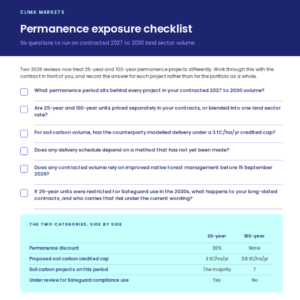
Where does this go next
The forecast worth holding is that permanence category stops being a footnote in an ACCU contract and becomes a priced attribute, with the first real evidence arriving in the Government’s response in February 2027 and the buffer and discount assessment at the end of that year. Registration data is the series to watch in the meantime. The next reading comes with the September quarter report.
FAQ
- Are 25-year permanence ACCUs going to be banned from Safeguard compliance? No decision has been made. The Climate Change Authority recommended assessing whether they remain appropriate, and stated it is not recommending removal or immediate change. Any change would require further analysis, consultation and transition arrangements. The Government’s response is due by 27 February 2027.
- Does the soil carbon cap reduce ACCU supply in 2026? No. CER expects the proposed cap to affect a small minority of soil carbon projects, mostly in early project years or where sampling is limited. First half 2026 issuance was a record 10.9 million ACCUs.
- Should we stop contracting soil carbon volume? The exposure sits in delivery timing and permanence category. Ask for the permanence period, the sampling schedule, and modelled delivery under the proposed cap before deciding.
- When will IFLM units be available? A draft final method goes to ERAC by the end of 2026. Soil carbon is sequenced after version one, so IFLM soil volume is not a 2027 planning assumption.
- Does any of this change our 2027 obligation? Safeguard Mechanism changes will generally take effect from 1 July 2030. The near-term work is contractual: knowing what permanence category your volume sits in.
- Are carbon farming ACCUs priced differently from other ACCUs? Yes. The generic spot price covers trades with an unspecified method and does not represent what any single method clears at.
Understand the method pricing before making your next buying decision
Try it free → markets.clima.com.au
No credit card required.
Sources
- [CCA] 2026 ACCU Scheme review FAQs: https://www.climatechangeauthority.gov.au/2026-accu-scheme-review-faqs
- [CCA] 2026 Review of the ACCU Scheme: https://www.climatechangeauthority.gov.au/publications/2026-review-australian-carbon-credit-units-scheme
- CER, QCMR June quarter 2026: https://cer.gov.au/markets/reports-and-data/quarterly-carbon-market-reports/quarterly-carbon-market-report-june-quarter-2026/australian-environmental-markets
- ERAC periodic review of the soil organic carbon method 2021: https://www.dcceew.gov.au/sites/default/files/documents/periodic-review-soil-organic-carbon-method-2021.pdf
- DCCEEW consultation on the soil organic carbon method 2021 Supplement: https://consult.dcceew.gov.au/proposed-change-to-the-soil-organic-carbon-method-2021-supplement
- DCCEEW IFLM method page, via CER QCMR June quarter 2026: https://www.dcceew.gov.au/climate-change/emissions-reduction/accu-scheme/methods/integrated-farm-and-land-management
- DCCEEW Improved Forest Management method page: https://www.dcceew.gov.au/climate-change/emissions-reduction/accu-scheme/methods/improved-forest-management
- DCCEEW ACCU Scheme methods page: https://www.dcceew.gov.au/climate-change/emissions-reduction/accu-scheme/methods/current
- DCCEEW 2026-27 Safeguard Mechanism review: https://consult.dcceew.gov.au/2026-27-safeguard-mechanism-review