



By Guy Dickinson,
Carbon and Environmental Markets, Corporate climate finance. Carbon markets. Transition plans. Scope 3.
When Version 2.0 of the SBTi Standard 2.0 dropped on 11 June, my first reaction was genuine respect. It goes further than most of us expected. My second, writing this a fortnight later as southern Europe swelters through another brutal heat event, is that further than expected and far enough are not the same sentence.
I want to be honest about that tension. The standard is a real step forward. It finally gives carbon projects a credible, accountable home. Measured against the physics, against what this decade actually demands, it is well short. Both are true, and pretending otherwise helps no one.
The real question is not whether Standard 2.0 is enough. It is what the standard now forces you to build, and when.
TL;DR: where you should land, by profile
| If you are | The signal in Standard 2.0 | What to do now |
|---|---|---|
| A large Australian emitter with a net-zero target | The Ongoing Emissions Responsibility (OER) becomes mandatory from 2035, ratcheting to 100% by your net-zero year | Declare a tier at validation. Start pricing an ongoing carbon-finance position into your plan |
| A Safeguard Mechanism facility | Your Scope 1 is already paced by baselines and Australian Carbon Credit Unit (ACCU) surrenders | Treat the OER as the Scope 3 layer on top, not a replacement for what the Safeguard already requires |
| Anyone with a net-zero year on the books | In that year, neutralisation is removals-only. Avoidance and reduction credits stop qualifying | Build a durable-removals position early, before 2035 demand arrives at scale |
The vacuum that just got filled
Climate Active has been in reform limbo since 2023. Plenty of companies built genuine programs around it. Plenty more are stuck on the same question: what role do carbon projects actually play in a net-zero strategy?
Meanwhile, mandatory climate disclosure under AASB S2 has arrived. Group 2 entities, meaning revenue over 200m or gross asset over 500m, start their first mandatory reporting period on 1 July 2026. That is now. So the question of what best-practice corporate climate action looks like has never mattered more. With over 10,000 companies already holding validated targets, representing more than 40% of global market capitalization, the SBTi’s answer carries weight.
Carbon projects finally get a home
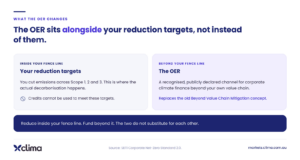
The headline addition is the Ongoing Emissions Responsibility (OER) program. It replaces the old Beyond Value Chain Mitigation concept, which had the right intention and was nearly impossible to operationalise, with something tiered and actionable.
Architecture is the important part. The OER sits alongside your reduction targets, not instead of them. Credits cannot be used to hit your Scope 1, 2 or 3 reduction goals. What the OER creates is a recognised, publicly declared channel for corporate climate finance beyond your own fence line.
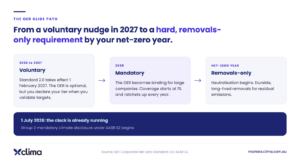
It is voluntary today. From 2035 it becomes mandatory for large companies, starting at 1% coverage and rising to 100% by each company’s net-zero year. Every company declares its tier at validation. That is the part worth circling: a hard requirement, signalled the better part of a decade early.
The OER glide path, from voluntary nudge to hard requirement
| Phase | Status | What it means |
|---|---|---|
| 2026 to 2027 | Voluntary | Standard 2.0 effective 1 February 2027. The OER is optional, but you declare your tier at target validation |
| 2035 | Mandatory | The OER becomes binding for large companies. Coverage starts at 1% and ratchets up every year |
| Net-zero year | Removals-only | Neutralisation kicks in. Durable removals for residual emissions. Avoidance and reduction credits no longer qualify |
One date sits underneath all of this: 1 July 2026, when Group 2 mandatory climate disclosure under AASB S2 begins. The clock is already running.
Removals are the real tell
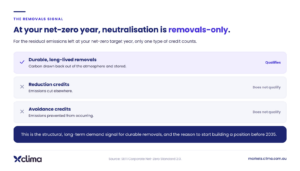
One distinction matters more than the rest. At the net-zero target year, the OER gives way to a neutralisation requirement that is removals-only. Durable, long-lived removals for residual emissions. Avoidance and reduction credits do not qualify at that stage.
That is the structural long-term demand signal for removals, and the reason to start building a position now, well before 2035 demand arrives at scale. A buyer who waits for the requirement to bind is buying into a thinner, more expensive market than the one available today.
Why mitigation alone no longer cuts it
I am writing this as another searing heatwave bakes southern Europe, the kind of event we used to call once-in-a-generation and now pencil in for most summers. That is the context this standard landed in, and it changes how I read it. Years in this market taught me to celebrate progress. The thermometer is teaching me not to mistake progress for sufficiency.
There is a bitter irony in the timing. The standard arrives just as hard-right denialism is resurgent and the politics of mitigation stalls. That backlash is, perversely, the wake-up call. When the policy ratchet jams, physical risk does not pause politely. It compounds. The honest response is mitigation plus resilience, and it starts now.
Look at the state of play in Europe and the abstraction falls away. The continent is warming at roughly twice the global rate, the fastest-warming continent on Earth, and the last few summers have stacked record on record. 2023 was Europe’s hottest year measured. The 2022 heatwaves are linked to more than 60,000 excess deaths. 2024 delivered the most days of extreme heat stress the modern record has seen. This is no longer a forecast to plan against. It is the operating environment.
For business, resilience is concrete. Heat exposure for your workforce. Water security. Supply chains that snap in a 45°C week. Physical-asset risk you now have to disclose under AASB S2. It also means using climate finance for what it can uniquely do. The OER’s Leadership tier explicitly funds adaptation, resilience, and loss and damage, not only tonnes avoided.
So what does resilience look like in a world that swings between 45°C summers and brutal cold snaps in the same year? It looks like designing for the range, not the average. Stress-testing operations against both extremes. Diversifying suppliers so a single climate shock cannot halt production. Protecting workers and customers with real adaptation plans rather than policies in a drawer. Pricing physical risk honestly into capital decisions today. Resilience is the insurance you buy precisely because mitigation is running late. The two have to advance together.
What I would do right now
For most Australian companies, emissions sit in Scope 3, which puts the Advanced or Leadership tier in frame for anyone serious. Think about the portfolio in layers.
Nature-based removals, meaning Soil Carbon, Plantation Forestry, reforestation, environmental plantings, and Savanna as a new method, are a core ongoing position and central to Australia’s own 1.5°C pathway. No credible scenario reaches that pathway without nature-based removal at scale.
The framing that holds up is corporate climate finance, high-integrity carbon projects, and compensation for ongoing emissions. With ASIC issuing greenwashing penalties, the words you choose carry real legal weight. This is where market information earns its place. Clima Markets exists to give buyers daily pricing across ACCU methodologies and the supply picture behind them, so a removal position can be built on data rather than on hearsay.
Further than expected. Short of enough.
Standard 2.0 gives companies at any level a principled, practical place to start, and the OER is where I would begin. Tiered, actionable, and finally a recognised role for carbon projects inside the most credible framework going. You do not need full validation on day one. You do need to start.
Understand the method pricing before making your next buying decision.
Try it free → markets.clima.com.au
No credit card required.
FAQ
What is the SBTi Ongoing Emissions Responsibility (OER)?
The OER is a program introduced in SBTi Standard 2.0 that creates a declared channel for corporate climate finance beyond a company’s own value chain. It replaces the earlier Beyond Value Chain Mitigation concept. It sits alongside reduction targets and cannot be used to meet Scope 1, 2 or 3 reduction goals.
Does the OER let companies offset their way to net zero?
No. Credits under the OER cannot count toward reduction targets. At the net-zero target year, neutralisation is removals-only, so avoidance and reduction credits stop qualifying for residual emissions.
When does the OER become mandatory?
It is voluntary from the standard’s effective date and becomes mandatory for large companies from 2035, starting at 1% coverage and rising to 100% by each company’s net-zero year. Companies declare their tier at target validation.
What does Standard 2.0 mean for Australian Safeguard Mechanism facilities?
Safeguard facilities already manage Scope 1 through declining baselines and ACCU surrenders. The OER applies to the ongoing and Scope 3 layer on top of that, so it adds a corporate-finance obligation rather than replacing the Safeguard requirement.
Why do removals matter more than avoidance credits under the new standard?
Because the net-zero-year neutralisation requirement is removals-only. That makes durable removals a structural long-term demand category, which is why building a position early, before the 2035 ratchet, is worth considering now.