


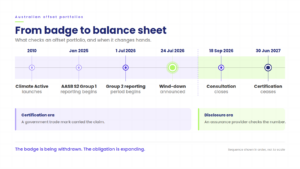
On 24 July 2026 the Department of Climate Change, Energy, the Environment and Water (DCCEEW) announced it plans to end Climate Active certification and opened a consultation on whether to close the program entirely or keep some voluntary standards and guidance. Submissions close on 18 September 2026, and certification is expected to cease on 30 June 2027.
For sixteen years that scheme was the thing that made a corporate offset purchase legible to the outside world. Most guidance on building a carbon offset portfolio was written on the assumption it would keep existing.
What a carbon offset portfolio is
A carbon offset portfolio is the set of carbon credit holdings and forward purchase commitments an organisation assembles to account for emissions it has not yet eliminated. It is spread across more than one project type, more than one crediting method, and usually more than one delivery year, so that the retirement of any single project or the closure of any single method does not leave the commitment exposed. The unit at the center of it in Australia is the Australian Carbon Credit Unit (ACCU), each one representing one tonne of carbon dioxide equivalent stored or avoided by a registered project.
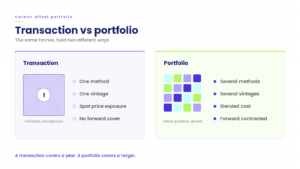
The word doing the work in that definition is a portfolio. A single bulk purchase of cheap units is a transaction. A portfolio is a position held over several years against a target you must report against.
Read this table if you read nothing else
| Question | Short answer |
| Does an offset portfolio still count towards net zero? | Yes, for the residual emissions you cannot cut, not as a substitute for cutting them. |
| What changed in 2026? | Government certification of the claim is being withdrawn. The reporting obligation is not. |
| Who checks the portfolio now? | Your auditor, under AASB S2, is alongside the financial statements. |
| Where does the supply pressure come from? | Safeguard Mechanism facilities, which surrendered 10.8 million ACCUs for the 2024-25 period. |
| What decides the price of what you buy? | The method behind the unit, more than the vintage or the volume. |
Why the end of Climate Active changes what a portfolio is for
Climate Active gave organisations a government trademark to put on a claim. DCCEEW’s position is that the context for voluntary climate action has changed, with mandatory climate financial disclosure and the reformed Safeguard Mechanism now driving corporate action instead. Certification is wound down in four stages.
That removes the badge. It does not remove the emissions, the target, or the disclosure.
What replaces the badge is an audit.
Under AASB S2 Climate-related Disclosures, in-scope entities lodge a sustainability report with ASIC alongside the annual financial report, covering governance, strategy, risk management, and metrics and targets including Scope 1, Scope 2 and Scope 3 emissions. Group 1 entities have been reporting for annual periods beginning on or after 1 January 2025. Group 2 entities began their first mandatory reporting period on 1 July 2026, and Group 3 follows from 1 July 2027. Scope 3 becomes mandatory from an entity’s second reporting period.
The practical shift is who reads the portfolio. It used to be customers and procurement teams. It is now an assurance provider asking where each unit came from, what it cost, and what contract secures the ones you have committed to but not yet received.
Why the method behind a unit decides what the portfolio is worth
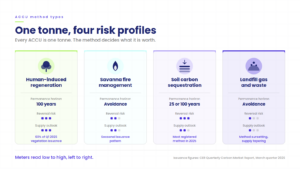
Every ACCU is one tonne. Every ACCU is not the same asset, because the method that generated it carries a different permanence profile, a different reversal risk, and a different supply outlook.
The Clean Energy Regulator (CER) issued a record of 5.5 million ACCUs in the March quarter of 2026, beating the previous quarterly record of 3.8 million set in 2024. Vegetation projects accounted for 3.7 million of that quarter’s issuance, and 60 per cent of the vegetation total came from human-induced regeneration. Issuance for the full year is tracking the CER’s estimated range of 22 to 26 million.
Concentration like that is a portfolio of input. When most of the supply reaching the market in a quarter comes from one method, a portfolio built entirely on that method inherits whatever happens to it.
Documenting a position at method level is what makes it defensible. Forest Farm (ERF183334) is a registered project in Ballina, New South Wales, running under the Plantation Forestry Methodology Determination 2022, which credits the transition of an existing plantation to permanent forest. Its credit period runs to 31 July 2048. Its permanence period runs to 14 January 2125, a hundred-year obligation that outlasts the crediting period by 77 years. A holding recorded only as a tonnage of Australian offsets carries none of that, and none of it can be reconstructed later.
Clima Markets holds supply and a commercial position in this market. What the platform provides is daily pricing by method and registry-verified project data for the units listed on it, so a buyer can see what separates one method’s price from another before committing to a multi-year position.
What Safeguard demand tells voluntary buyers about the supply they are competing for
Voluntary buyers are on the small side of this market, and it is worth being direct about that.
Of the 208 facilities covered by the Safeguard Mechanism for the 2024-25 reporting period, 141 exceeded their baselines, with total excess emissions of 13.7 Mt CO2-e. Those entities surrendered 10.8 million ACCUs and 2.6 million Safeguard Mechanism Credits to manage it. Over the same March quarter, cancellations for voluntary disclosure not tied to Safeguard surrenders came to 0.2 million ACCUs, up 8 per cent on the same quarter a year earlier.
ACCU holdings outside the cost containment measure fell by 4.2 million to 56.5 million at the end of Q1 2026. The CER expects a drawdown of accumulated holdings later this decade as Safeguard baselines decline.
A voluntary buyer is therefore sourcing from a pool whose price is set by a compliance obligation that ratchets tighter every year. That is the argument for forward contracting rather than annual spot purchasing, and it is an argument about timing, not about virtue.
Where a carbon offset portfolio stops helping
An offset portfolio can support a net zero plan, but it cannot carry the plan by itself. These are the points where offsets stop being useful and the underlying emissions, claims, data, or pricing decisions still need to stand on their own.
- It does not reduce emissions; it only accounts for them. Under both AASB S2 and the Safeguard Mechanism, the gross emissions figure is still disclosed. If the emissions curve stays flat while the portfolio grows, the disclosure will show that clearly.
- It does not protect a public claim anymore. The claim you make about the portfolio now sits with the entity and its directors rather than with a government certification.
- It does not produce your Scope 3 data. Value chain emissions mostly come from other companies’ operations, so buying units does not supply the activity data, supplier evidence, or calculation basis that Scope 3 disclosure requires from the second reporting period.
- It does not price itself. The blended cost of a portfolio depends on the method mix and contract structure. Without daily visibility on method pricing, the portfolio will usually tilt toward whatever was easiest to source that quarter, not necessarily toward the best fit for the target.
FAQ
- Do I still need a carbon offset portfolio in 2026 if Climate Active is ending?
If you have a net zero target and residual emissions, yes. The certification pathway is closing, but the disclosure obligation under AASB S2 is expanding, and the portfolio is what backs up the residual emissions figure in that disclosure.
- How many methods should a carbon offset portfolio hold?
There is no regulated minimum. The practical test is whether the closure or reversal of a single method would leave your target uncovered. Q1 2026 issuance concentration shows how quickly a single-method position becomes a single point of failure.
- Should the portfolio be bought on spot or contracted forward?
Safeguard’s baselines decline every year, and the CER expects holdings to draw later this decade. That points towards forward cover for the volume you are certain about, with spots used for the remainder. The tradeoff is that forward commitments tie up capital against a target that may itself be revised.
- Does an ACCU portfolio cover international operations? No. ACCUs are issued under the Australian scheme. Offshore entities in your consolidated group will usually need units recognised in their own jurisdiction, which is a separate procurement question.
Understand the method pricing before making your next buying decision
Daily pricing across ACCU methods, with registry-verified project data.
Try it free → markets.clima.com.au