


Carbon credits and carbon offsets are closely connected, which is why the terms are often used interchangeably. But they describe different parts of the emissions management process.
A carbon credit is a unit representing one tonne of carbon dioxide equivalent (CO₂-e) reduced, avoided, or removed through an eligible project. A carbon offset is the use of carbon credits to compensate for greenhouse gas emissions produced elsewhere.
For Australian businesses, understanding this distinction is particularly useful when navigating Australian Carbon Credit Units (ACCUs), voluntary climate commitments, and broader emissions management strategies.
This guide explains the difference between carbon credits and carbon offsets, how they work together, and where ACCUs fit into the picture.
Carbon Credits vs Carbon Offsets: Quick Comparison
| Carbon Credits | Carbon Offsets |
| Represent verified emissions reductions or removals | Compensate for emissions produced elsewhere |
| One credit represents one tonne of CO₂-e. | Offsetting involves using credits against emissions. |
| Generated through eligible projects | Occurs when credits are used for compensation |
| Can be bought and sold | Represents the outcome of using credits |
| Can exist before being used | Requires credits to be cancelled or retired against emissions |
The simplest way to remember the difference is
Carbon credit = the unit. Carbon offset = how the unit is used.
What Are Carbon Credits?
Carbon credits provide a measurable unit for emissions reductions, avoidance, or removals achieved through eligible projects.
In Australia, the Australian Carbon Credit Unit (ACCU) Scheme supports eligible projects that reduce or avoid greenhouse gas emissions or remove and store carbon from the atmosphere.
Participants can earn one ACCU for every tonne of CO₂-e stored or avoided by an eligible project.
Projects may involve activities across areas such as vegetation management, agriculture, forestry, energy consumption, waste, transport, and industrial processes.
Before credits can be issued, projects must meet eligibility requirements and follow approved methods for calculating their carbon abatement. These methods are designed to ensure the claimed emissions outcomes can be measured and verified.
Once issued, ACCUs can be held, bought, or sold, including through Australia’s secondary carbon market.
Related reading: Learn more about how credits are generated and used in What Are Carbon Credits and How Do They Work?
What Are Carbon Offsets?
A carbon offset is the use of carbon credits to compensate for greenhouse gas emissions produced elsewhere.
Consider a business that has already taken steps to reduce its operational emissions but still produces emissions it cannot currently eliminate.
Rather than treating the remaining emissions as reduced, the business may acquire eligible carbon credits representing reductions or removals achieved by another project. Those credits can then be cancelled against its emissions as part of its offsetting approach.
Under Australia’s ACCU framework, ACCU account holders can voluntarily cancel ACCUs in the Australian National Registry of Emissions Units (ANREU) to offset greenhouse gas emissions.
Once cancelled, the ACCU is removed from circulation and cannot subsequently be transferred or used for another purpose.
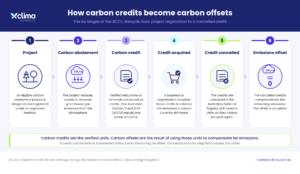
Carbon offsets, therefore, don’t create the emissions reduction themselves. They depend on carbon credits generated from projects that have already delivered the underlying carbon abatement.
Why Are Carbon Credits and Carbon Offsets Confused?
The confusion largely comes from the fact that the two concepts operate together.
A business purchasing carbon credits may ultimately intend to use those credits for offsetting. As a result, conversations about “buying offsets” and “buying credits” can sound as though they describe the same transaction.
But there is an important distinction.
A carbon credit can exist without being used as an offset. It may be held or transferred between market participants.
An offset occurs when credits are actually applied to compensate for emissions, including through cancellation where applicable.
Keeping this distinction clear helps businesses communicate their climate actions more accurately and understand what happens to a carbon credit throughout its lifecycle.
How Carbon Credits and Carbon Offsets Work Together
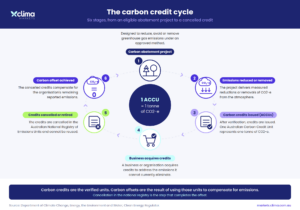
Although carbon credits and carbon offsets are different, they are closely connected. One cannot exist without the other.
Carbon credits are generated through eligible carbon abatement projects that reduce, avoid, or remove greenhouse gas emissions. These credits can then be acquired by businesses or organizations seeking to compensate for emissions that cannot currently be eliminated.
When those credits are used to compensate for greenhouse gas emissions, they become part of a carbon offset.
The process can be understood as a simple lifecycle:
Carbon Credits and Carbon Offsets in Australia
Australia’s carbon market operates through the Australian Carbon Credit Unit (ACCU) Scheme, which supports projects that reduce greenhouse gas emissions or remove carbon dioxide from the atmosphere.
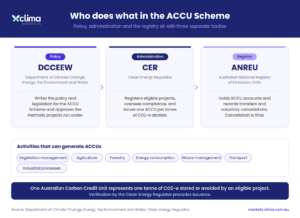
Eligible projects can involve:
- Vegetation management
- Agriculture
- Forestry
- Energy consumption
- Waste management
- Transport
- Industrial processes
Under the scheme, participants can earn one ACCU for every tonne of carbon dioxide equivalent (CO₂-e) stored or avoided by an eligible project.
The Department of Climate Change, Energy, the Environment and Water (DCCEEW) develops the policy and legislation for the scheme, while the Clean Energy Regulator (CER) administers eligible projects, oversees compliance and manages the issuance of ACCUs.
This framework helps ensure carbon credits issued under the ACCU Scheme are supported by approved methodologies and verified emissions reductions.
A Practical Example
Imagine an Australian manufacturing company has already improved its energy efficiency, upgraded equipment, and reduced electricity consumption. Despite these efforts, some greenhouse gas emissions remain unavoidable.
Instead of claiming those emissions have disappeared, the business chooses to acquire ACCUs generated by an eligible reforestation project operating under the ACCU Scheme.
The reforestation project has followed an approved methodology, measured its carbon storage, and received ACCUs after verification by the Clean Energy Regulator.
Once the manufacturing company uses those ACCUs to compensate for its remaining emissions, the credits are cancelled within the registry.
In this example:
- The reforestation project created the carbon credits.
- The manufacturing company created the carbon offset by using those credits to compensate for its emissions.
This illustrates why the two terms should not be used interchangeably.
Can Carbon Credits Exist Without Carbon Offsets?
Yes.
A carbon credit can exist without immediately becoming a carbon offset.
For example, a business may:
- Hold carbon credits for future use.
- Purchase credits as part of a long-term emissions strategy.
- Transfer credits to another eligible market participant.
- Trade credits within the carbon market.
The credit only contributes to a carbon offset when it is used to compensate for greenhouse gas emissions.
This distinction is particularly relevant in Australia’s carbon market, where ACCUs may be held, transferred, or voluntarily cancelled depending on how they are intended to be used.
Why Understanding the Difference Matters
Using the correct terminology helps businesses communicate their climate strategies more accurately.
Confusing carbon credits with carbon offsets can create misunderstandings about what an organization has actually achieved.
For example, purchasing carbon credits does not automatically mean emissions have been offset. Credits only become part of an offsetting strategy when they are applied to compensate for greenhouse gas emissions.
Understanding this difference also makes it easier to evaluate carbon market information, sustainability reporting, and emissions reduction initiatives with greater confidence.
Benefits of Understanding the Difference
Understanding the difference between carbon credits and carbon offsets helps businesses make more informed decisions about emissions management and sustainability reporting.
A clear understanding can help organizations:
- Use climate terminology accurately.
- Build credible emissions management strategies.
- Better evaluate carbon market opportunities.
- Support verified carbon abatement projects.
- Improve transparency in sustainability reporting.
Rather than viewing carbon credits and carbon offsets as competing concepts, businesses should understand how they complement each other within a broader climate strategy.
Carbon Credits and Carbon Offsets: Key Differences at a Glance
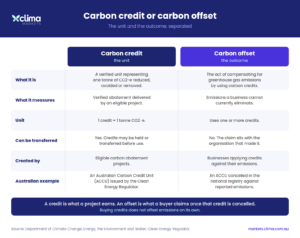
Common Misconceptions
Because the terms are often used together, several misconceptions continue to appear in discussions about carbon markets.
- Myth 1: Carbon credits and carbon offsets are the same.
- Reality: Carbon credits are verified units representing emissions reductions, while carbon offsets are achieved when those credits are used to compensate for emissions.
- Myth 2: Buying carbon credits automatically offsets emissions.
- Reality: Purchasing carbon credits alone does not create a carbon offset. Credits generally need to be applied towards greenhouse gas emissions before they become part of an offsetting strategy.
- Myth 3: Carbon offsets replace emissions reduction.
- Reality: Carbon offsets are intended to complement emissions reduction efforts, not replace them. Businesses should prioritize reducing emissions wherever practical before considering offsetting remaining emissions.
Although carbon credits and carbon offsets are closely connected, they serve different purposes within an emissions management strategy.
Carbon credits represent verified emissions reductions or removals generated through eligible carbon abatement projects. Carbon offsets are achieved when those credits are used to compensate for greenhouse gas emissions that cannot currently be avoided.
Understanding this distinction helps businesses communicate more accurately, evaluate carbon market opportunities with greater confidence, and develop climate strategies based on verified emissions outcomes rather than commonly misunderstood terminology.
Whether your organization is beginning its emissions management journey or expanding an existing climate strategy, recognizing how carbon credits and carbon offsets work together provides a stronger foundation for informed decision-making.
Understanding the difference between carbon credits and carbon offsets is an important first step in navigating Australia’s carbon market.
Clima Markets provides Australian carbon market insights, methodology-level pricing, and market information to help businesses better understand ACCUs and the broader carbon market.
Explore the latest Australian carbon market insights at markets.clima.com.au.
Frequently Asked Questions
What is the main difference between carbon credits and carbon offsets?
A carbon credit is a verified unit representing one tonne of carbon dioxide equivalent (CO₂-e) reduced, avoided, or removed. A carbon offset is created when those credits are used to compensate for greenhouse gas emissions.
Can carbon credits exist without carbon offsets?
Yes. Carbon credits can be held, transferred, or acquired without being used to offset emissions immediately.
Can a carbon offset exist without carbon credits?
No. Carbon offsets depend on carbon credits generated through eligible carbon abatement projects.
What is an ACCU?
An Australian Carbon Credit Unit (ACCU) is Australia’s official carbon credit. Each ACCU represents one tonne of carbon dioxide equivalent (CO₂-e) stored or avoided through an eligible project.
Why are carbon credits and carbon offsets often confused?
The terms are closely connected because carbon offsets rely on carbon credits. However, they describe different stages of the emissions management process—carbon credits are the verified units, while carbon offsets are the outcome of using those units.